

How Reliable Are Market Predictions?
Market predictions are often treated like a compass in murky waters — you rely on them to guide decisions, yet they’re frequently off-target. So, how reliable are they really? The short answer is: market predictions can provide directional clues, but you shouldn’t use them as gospel. Understanding their limitations, context, and the role assets play — particularly inflation-fighting assets — can help you use them as tools rather than strict forecasts.
TL;DR
- Market predictions can inform but should not dictate your investment decisions.
- Inflation-fighting assets such as commodities and TIPS influence forecasting models due to their role in economic cycles.
- Improving prediction accuracy involves understanding psychology, data patterns, and macroeconomic indicators.
- Future of market forecasts lies in the integration of AI, macro-data, and real-time analytics.
- You should treat forecasts as part of a broader strategic toolkit, not a crystal ball.
Understanding the Flaws in Market Forecasts
Imagine trying to predict where a leaf will land as it falls during a storm — that’s often how analysts feel when creating market predictions. Despite advanced models and powerful computing, the environment remains chaotic. There are several inherent issues with market predictions:
- Human Bias: Analyst forecasts often succumb to optimism or pessimism bias.
- Noisy Data: Markets are affected by countless variables, many of which are unpredictable or unknown.
- Lagging Indicators: Many forecasting models rely on historical data, which may not reflect rapid shifts like geopolitical events or pandemics.
Here’s what often happens: You watch market predictions, hear that tech stocks will soar, pile in — only to see an energy sector rally instead. Why? Because unexpected inflation data or global tension flipped the script. This doesn’t mean all market predictions are worthless, but it does highlight why a critical approach is vital.
In practice, consider using forecasts as a directional tool. They offer insights into what professionals and economists are emphasizing — not certainties. A sound strategy blends educated market predictions with fundamental and technical analysis, plus checking predictions against your portfolio goals and risk tolerance.

The Role of Inflation-Fighting Assets in Predictions
Inflation-fighting assets — like Treasury Inflation-Protected Securities (TIPS), commodities, and real estate — aren’t just portfolio diversifiers. They’re narrative shapers in market predictions. When inflation rises or looms, money shifts into these assets. As that shift occurs, it signals underlying sentiment about the economy and affects how future market predictions are formed.
Think of inflation like termites in a wooden house — slowly eating away at the purchasing power of your money. Inflation-fighting assets that resist this erosion become central figures in any forecast model. Analysts watch inflows into TIPS, gold, and cyclical commodities to gauge market expectations around central bank actions, rate hikes, and economic slowdowns.
In periods where inflation surprises to the upside, market predictions centered on high-growth stocks become less reliable, and commodity-heavy sectors draw attention. If you’re reading a forecast without knowing the position or importance of these inflation-fighting assets, you’re likely misinterpreting the bigger story.
By tracking inflation-fighting assets and understanding their behavior, you gain an edge in interpreting market predictions. You’re not only seeing where money is flowing but why — and that can make forecast reading far more meaningful for improving prediction accuracy.
Key Factors Impacting Market Predictions
Despite their flaws, market predictions often incorporate a mosaic of elements. Here are the most influential players that shape these market narratives:
- Macroeconomic Indicators: GDP growth, employment data, and inflation numbers all directly affect investor sentiment and prediction models.
- Central Bank Policies: Fed announcements, interest rate cues, and liquidity decisions are major drivers shifting predictive curves.
- Investor Sentiment: Fear and greed indexes, social media trends, and even retail investing surges can influence short-term market predictions.
- Global Events: Geopolitical tensions, pandemics, or supply chain disruptions often blindside even the most sophisticated models.
| Factor | Impact on Predictions |
|---|---|
| Inflation | Shifts capital to inflation-fighting assets; alters growth assumptions |
| Interest Rates | Revaluates debt sensitivity of sectors, impacting equity forecasts |
| Consumer Confidence | Informs retail behavior; directs capital toward or away from risk |
Staying attentive to these dynamics gives you a decoder ring for market predictions. You begin to see them not as magical outcomes, but as data-informed guesses — colorful, complex, and context-rich. The more you understand what’s baked into the model, the sharper your interpretation becomes for improving prediction accuracy.
Strategies for Improving Prediction Accuracy
Let’s be straight: you won’t ever predict the market with perfect certainty — but you can absolutely improve your prediction accuracy with smarter approaches. Here’s how:
- Incorporate Multi-Signal Analysis: Combine technical signals, macro indicators, and sentiment data to develop a triangulated view versus relying on one tool for market predictions.
- Use Scenario Planning: Don’t predict one outcome — build plausible scenarios (bull, base, bear) and prepare for them with flexible strategies.
- Track Smart Money Flows: Watch institutional investor positioning and their reaction to economic data releases.
- Validate with Backtesting: Test your model or thesis against past events. It won’t predict the future directly but shows how variables perform under stress.
- Monitor Predictive Signals from Inflation Assets: Watching TIPS and related ETF flows often gives clues into inflation expectation shifts that affect market predictions.
Here’s what often works best in practice for improving prediction accuracy: don’t chase the forecast — deconstruct it. Ask, “What data is this based on?” and “What’s the underlying assumption here?” That simple curiosity can dramatically enhance your ability to navigate market noise and understand the future of market forecasts.
Cost Guide: Data, Tools & Resources
| Resource Type | Low-End | Mid-Range | High-End |
|---|---|---|---|
| Stock Forecast Subscriptions | $10/month | $50/month | $200+/month |
| Economic Indicators Platform | Free (basic) | $30/month | $150/month |
| Research Reports | $25/report | $100/report | $500+/report |
Start small with low-cost insights or free platforms, then work your way up if deeper data serves your strategy. Always match the cost to the clarity it brings your investing decisions and focus on improving prediction accuracy rather than chasing expensive tools.
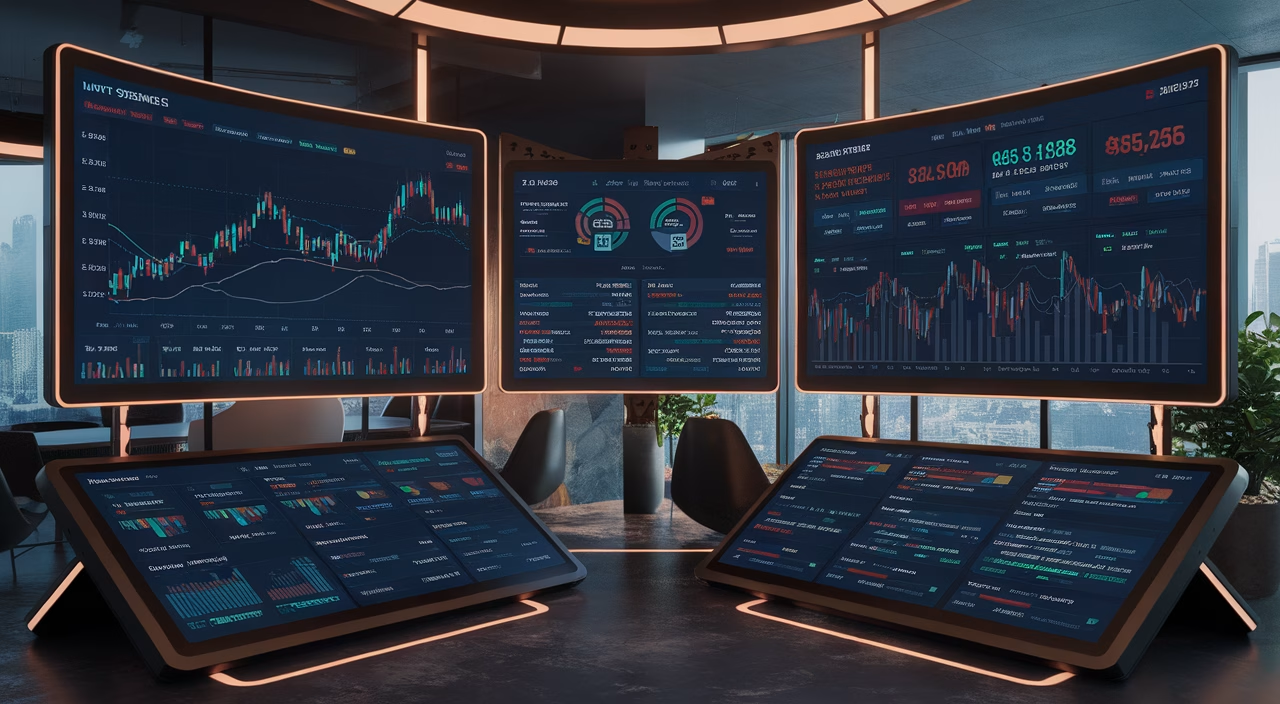
The Future of Market Forecasts and Predictions
The future of market forecasts doesn’t live in the past — it’s being built on algorithms, machine learning, and behavioral finance. Legacy models, built on assumed rationality, are giving way to new systems that reflect emotional, real-time market behaviors and focus on improving prediction accuracy.
So, what might shape the future of market forecasts?
- Artificial Intelligence: AI-driven platforms analyze patterns across datasets faster and more comprehensively than humans, revolutionizing market predictions.
- Real-Time Sentiment Analysis: Mining social media and forum chatter is becoming mainstream for gauging crowd behavior in market predictions.
- Behavioral Finance Integration: Volatility clustering, recency bias, and loss aversion are being baked into predictive analytics.
- Higher-Frequency Updates: Traditional quarterly guidance is being challenged by weekly or even daily forecast frameworks.
The bottom line is this: the market is a living organism, constantly moving. The most reliable market predictions will fuse data, context, and emotion in balanced proportions. As we move forward, you’ll do best by treating the future of market forecasts like weather predictions — useful guidance, not unchangeable truths.
Final Thoughts
Market predictions aren’t about seeing the future — they’re about understanding the possible. Think of them as maps, not oracles. Used wisely, they help you navigate; used blindly, they lead you off the cliff.
As an investor, your edge lies in asking better questions, contextualizing market predictions with economic and emotional variables, and keeping a flexible strategy that bends without breaking. Focus on improving prediction accuracy through multiple data sources and remember that inflation-fighting assets often signal broader economic shifts that affect the future of market forecasts.
Frequently Asked Questions
- How reliable are market predictions?
Market predictions offer directional insight but are prone to error due to unexpected events, emotional trading, and data complexities. - Are inflation-fighting assets a good barometer for forecasts?
Yes, because they reflect investor sentiment around inflation and often signal larger shifts in economic expectations. - What tools help investors refine prediction accuracy?
Combining macroeconomic analysis, technical indicators, AI-driven models, and sentiment trackers can help sharpen your edge. - Why do forecasts often miss the mark?
Factors like human bias, black swan events, and overreliance on historical data contribute to misses. - Can I build my own market prediction model?
Yes, with available data and tools, DIY models are feasible — but should be tested and used cautiously. - Is AI the future of market forecasting?
AI is already playing a major role, though it’s not infallible. It offers speed and pattern recognition, not clairvoyance. - Should I rely solely on forecasts to make decisions?
No, forecasts should be one tool among many in a broader investment strategy framework.

