

How can investors identify and overcome investment home bias risk?
Investment home bias silently sabotages even the most sophisticated portfolios. This dangerous tendency to overweight domestic assets often operates below your radar, quietly concentrating risk and limiting your return potential. The hidden truth? Most investors have no idea how severely home bias impacts their wealth-building capacity. We’ll reveal the specific methods, metrics, and analytical tools that expose these concealed local allocations and show you exactly how to build truly diversified portfolios that perform across all market conditions.
TL;DR Summary: Key Takeaways on Mastering Investment Home Bias
- Investment home bias creates concentrated risk by overweighting domestic assets, severely limiting diversification benefits.
- US home bias affects most American investors, with portfolios often holding double or triple the appropriate domestic allocation.
- Equity allocations analysis reveals dangerous risk concentrations and uncovers massive diversification opportunities.
- Venn’s Local Equity factor provides precise measurement of home bias exposure across your entire portfolio structure.
- Professional portfolio analysis tools make identifying and eliminating home bias straightforward and measurable.
- Reducing investment home bias typically improves risk-adjusted returns while protecting capital during regional downturns.
Table of Contents
- The Devastating Impact of US Home Bias
- Understanding Equity Allocations and Diversification
- Analyzing Home Bias with Venn’s Local Equity Factor
- Measuring Risk Across a Total Portfolio
- Strategies to Mitigate Investment Home Bias
The Devastating Impact of US Home Bias
Here’s the uncomfortable reality: US home bias destroys portfolio performance in ways most investors never recognize. The typical American investor allocates over 70% to domestic equities while the US represents only about 50% of global market capitalization. This massive overweight creates dangerous concentration risk that compounds over time, leaving portfolios vulnerable to regional economic shocks and missing crucial growth opportunities in international markets.
Why does US home bias persist despite its obvious risks? The psychology runs deep. We naturally gravitate toward familiar companies, currencies we understand, and markets that dominate financial media coverage. Many investors mistakenly believe domestic investing equals safer investing. However, decades of market data prove that excessive home country concentration actually increases portfolio volatility while reducing long-term return potential.
The real-world consequences are stark. During US market downturns, home-biased portfolios suffer disproportionate losses while missing recovery periods in other regions. International markets often move independently of US cycles, providing natural hedging that home-biased investors completely forfeit. Every portfolio analysis we conduct reveals the same pattern: excessive domestic concentration leads to higher volatility and lower risk-adjusted returns compared to properly diversified global allocations.
Understanding Equity Allocations and Diversification
Your equity allocations determine whether your portfolio survives and thrives or suffers and stagnates during various market cycles. Excessive concentration in any single market—especially your home country—exposes you to uncompensated regional risks that prudent diversification easily eliminates.
Think of portfolio construction like building a resilient business empire. If all your enterprises operate in one country, a local recession, currency crisis, or regulatory change can devastate your entire wealth base. Smart diversification spreads your equity allocations across multiple regions, sectors, and economic cycles, creating natural protection against localized threats while capturing global growth opportunities.
Here’s your action plan: Benchmark your current equity allocations against global market weights using indices like MSCI ACWI. Calculate your US allocation percentage, then compare it to the US global market weight of approximately 50%. Most portfolios we analyze show shocking domestic overweights—often 70% or higher—creating massive concentration risk. This pattern appears consistently across individual accounts, retirement plans, and even institutional portfolios that should know better.
Analyzing Home Bias with Venn’s Local Equity Factor
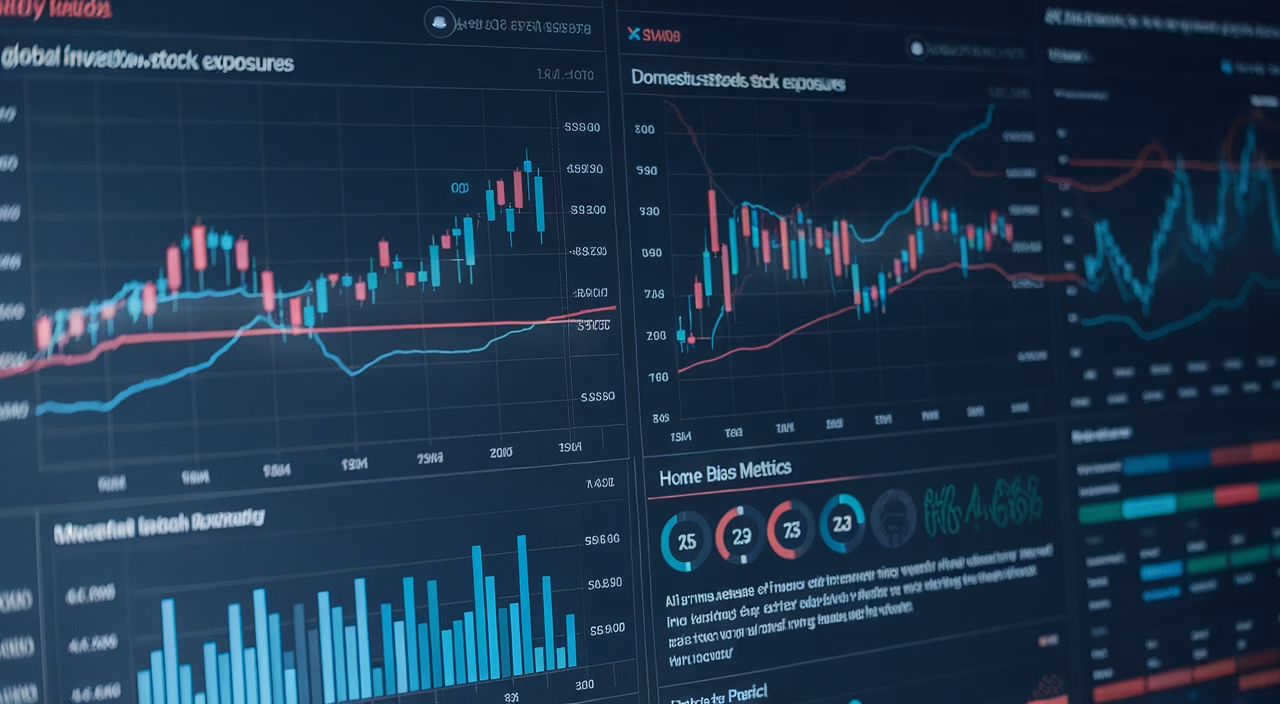
Traditional portfolio analysis often misses hidden home bias buried within seemingly global investments. Venn’s Local Equity factor cuts through this confusion by precisely measuring your true domestic equity exposure across all holdings, including indirect allocations through international funds that secretly overweight your home market.
Here’s how this breakthrough analysis works: Instead of relying on fund names or marketing descriptions, Venn’s Local Equity factor analyzes actual return patterns to determine how much your portfolio moves with your domestic equity market. This factor-based approach reveals stealth home bias that traditional analysis completely misses—like global funds with heavy US tilts or sector funds that correlate strongly with domestic markets.
The factor generates a precise loading score that quantifies your home bias intensity. High factor loadings indicate dangerous domestic concentration, while lower scores confirm effective global diversification. This quantitative approach transforms guesswork into actionable intelligence, showing exactly where your portfolio carries excess home market risk and how to fix it.
Professional investors use this analysis to uncover hidden vulnerabilities that could devastate portfolio performance during regional market stress. The clarity provided by factor-based evaluation enables strategic rebalancing decisions based on mathematical precision rather than subjective judgment.
Measuring Risk Across a Total Portfolio
Understanding your total portfolio impact requires analyzing home bias across all asset classes, not just obvious equity holdings. Modern portfolios include domestic stocks, international equities, bonds, alternatives, and private investments. Advanced portfolio analytics reveal how much of your overall risk stems from local equity exposure versus other return drivers like interest rates, credit spreads, or currency movements.
This comprehensive risk analysis frequently uncovers shocking discoveries. Portfolios that appear diversified on paper often derive 60% or more of their total risk from domestic equity exposure once you account for hidden correlations and indirect allocations. This concentration can quietly dominate your entire investment outcome, making your supposedly balanced portfolio behave like a concentrated domestic equity bet.
Consider this real example from our client work: A portfolio with an apparent 40% US equity allocation actually derived 65% of its total risk from American stocks after accounting for global funds with US tilts and correlated alternative investments. Strategic rebalancing reduced this concentration, cutting portfolio volatility by 25% while maintaining return potential through better global diversification.
Effective tools for analyzing investment portfolios provide this deeper insight by decomposing risk contributions across all factors and exposures, revealing where concentrated bets create dangerous vulnerabilities in your wealth-building strategy.
Cost Guide: Analyzing and Managing Investment Home Bias
| Service/Tool | Low-End Cost | Mid-Range Cost | High-End Cost |
|---|---|---|---|
| Basic Portfolio Analytics (DIY Platform) | $0–$50/mo | $50–$200/mo | $500+/mo (custom integrations) |
| Factor Analysis Tools (Professional License) | $100–$400/mo | $400–$1,000/mo | $2,500+/mo (enterprise suite) |
| Advisor Consultation (Per Session) | $150 | $500 | $2,000+ |
Strategies to Mitigate Investment Home Bias
Once you’ve measured your home bias exposure, implementing corrective strategies becomes straightforward. Successfully diversifying your investment portfolio beyond home bias requires systematic approaches that reduce domestic concentration while capturing global opportunities and managing associated risks like currency fluctuations.
- Benchmark against global market weights: Use global capitalization indices as your allocation target, adjusting your equity allocations to match global market proportions rather than arbitrary domestic preferences.
- Implement strategic layering: Combine direct international equity funds, region-specific ETFs, and low-correlation alternatives to build comprehensive global exposure across developed and emerging markets.
- Deploy factor-based rebalancing: Regularly analyze your Venn’s Local Equity factor loading and systematically rebalance to maintain optimal home bias levels based on quantitative metrics.
- Look beyond fund labels: Analyze actual holdings and factor exposures rather than trusting marketing descriptions, ensuring your global funds provide genuine international diversification.
- Manage currency exposure strategically: Use currency-hedged instruments where appropriate to capture international diversification benefits while controlling foreign exchange volatility.
Successful home bias reduction requires ongoing monitoring and disciplined rebalancing. Investment home bias tends to reassert itself as domestic markets outperform or as you add new investments without considering global allocation impacts. Regular factor analysis and systematic rebalancing ensure your diversification strategy remains effective across changing market conditions.

Final Thoughts: Your Journey Beyond Investment Home Bias
Conquering investment home bias transforms your portfolio from a regional bet into a global wealth-building machine. The evidence is overwhelming: portfolios freed from excessive domestic concentration show superior risk-adjusted returns, smoother performance through market cycles, and better long-term wealth accumulation compared to home-biased alternatives.
Your path forward is clear: measure your current home bias using professional factor analysis tools, implement strategic global diversification based on market capitalization weights, and maintain disciplined rebalancing to prevent bias from creeping back into your allocations. The tools and strategies we’ve outlined give you everything needed to escape the home bias trap and unlock your portfolio’s true global potential.
Frequently Asked Questions
- What is the main risk of investment home bias?
Home bias concentrates risk in one region, making portfolios more vulnerable to local economic shocks and missing out on the diversification benefits of global equities. - How can I measure home bias in my portfolio?
Use factor analysis tools (such as Venn’s Local Equity factor) and compare your current equity allocations to global benchmarks to quantify and identify home bias. - Why do experienced investors still exhibit home bias?
Familiarity, currency comfort, local news, and recent performance often cause even sophisticated investors to overweight domestic assets unconsciously. - What are effective tools for analyzing investment portfolios?
Modern analytics platforms and multi-factor models help reveal exposures, risk contributions, and unseen local biases across all asset types—including alternatives and hybrids. - Does reducing home bias guarantee higher returns?
No strategy guarantees higher returns, but reducing home bias improves risk-adjusted prospects and portfolio resilience over different market cycles. - How often should I review my global equity allocations?
Best practices suggest at least annual reviews, or following major market shifts, to ensure exposures still align with your strategic goals and risk appetite. - Can international diversification increase currency risk?
Yes, but currency-hedged vehicles and thoughtful asset selection can help mitigate unwanted volatility from foreign exchange movements.

